University of Cumbria welcomes healthcare leaders to the Barrow Campus
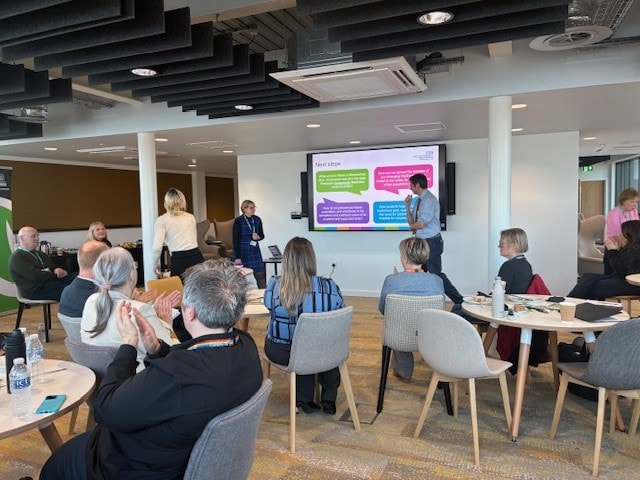
The University of Cumbria welcomed key healthcare leaders and regional stakeholders to its Barrow campus for an event focused on the future of community-based healthcare delivery and the growing impact of artificial intelligence (AI) and health technologies on the workforce.
Jointly hosted by the University of Cumbria Institute of Health (IoH) and the Pears Cumbria School of Medicine (PCSM), the event marked a significant opportunity for collaboration across the region - bringing together local innovation and shared expertise. It also provided a platform to highlight the university’s new state-of-the-art facilities, which opened to students in September 2025.
The central theme, ‘Workforce Planning: What does the application of health technologies and AI mean for future community-based healthcare delivery for Barrow?’ framed a series of presentations and discussions throughout the afternoon.
Professor Mary Morrell, Head of the Pears Cumbria School of Medicine, opened the event by outlining the growing importance of AI in modern healthcare and its relevance for Barrow, highlighting opportunities for students to engage with emerging technologies.
This was followed by a presentation from Dr Christopher Chiswell, Head of Prevention & Healthcare Delivery (PHD) at the Pears Cumbria School of Medicine and Consultant at University Hospitals of Morecambe Bay NHS Foundation Trust, on local AI-driven developments supporting workforce needs and sustainable healthcare delivery. Sarah Davies, Lecturer in Medical Science, also shared insights from her research in diagnostic radiography, illustrating how AI is already influencing clinical practice.
A collaborative discussion session invited stakeholders from across the region to reflect on local opportunities, share ongoing initiatives and identify ways to coordinate efforts to develop a healthcare workforce equipped to embrace AI and health technologies. These conversations will continue beyond the event as partners explore new avenues for joint working and skills development.
Professor Karen Stansfield, Dean of the Institute of Health, said: "Statistically, the Barrow area faces greater healthcare challenges than other parts of the UK. That is why, as a university, we feel it is so important our new campus provides opportunities for people to study and remain local, particularly those returning to education later in life. Currently we are offering adult nursing, and we hope to expand this provision in the coming years. This event was not only an excellent opportunity for knowledge sharing and discussion, but also a chance to showcase our new facilities to healthcare professionals from the region."
Professor Mary Morrell, Head of the Pears Cumbria School of Medicine said: “The Pears Cumbria School of Medicine is taking a new approach with our graduate medical programme. It has a regional focus and a bespoke curriculum, centred on prevention and innovation. As the School develops, it will prepare students for practise using digital technology. This means equipping future doctors in Barrow and Cumbria with cutting-edge tools to tackle local health inequalities and deliver patient-centred, community-based care.”
Alison Balson, Chief People Officer for UHMBT said: "We are excited about the possibilities that AI offers us to help in delivering high-class care for people in new ways to ensure that we give people an NHS fit for the 21st century.
"We are already creating innovative healthcare models for people in the Barrow area, keeping them out of hospital and enabling them to access the services they need when they need them, keeping them at home for longer - and we believe that a new digital future will enable us to continue expanding this work to help more people stay healthy and out of hospital for longer."
Initiatives like this are central to the University of Cumbria’s mission to enhance collaboration with local healthcare services, strengthen community-based provision and support the development of a highly skilled regional health workforce.